A Lie Tole Over and Over Again
How liars create the 'illusion of truth'
(Paradigm credit:
Getty Images
)

Repetition makes a fact seem more true, regardless of whether it is or non. Understanding this effect can assistance you avert falling for propaganda, says psychologist Tom Stafford.
"Repeat a lie often enough and it becomes the truth", is a law of propaganda often attributed to the Nazi Joseph Goebbels. Among psychologists something similar this known equally the "illusion of truth" effect. Here's how a typical experiment on the issue works: participants rate how true trivia items are, things like "A prune is a stale plum". Sometimes these items are true (similar that one), just sometimes participants see a parallel version which isn't truthful (something like "A engagement is a dried plum").
After a break – of minutes or even weeks – the participants do the procedure once more, just this time some of the items they rate are new, and some they saw before in the first phase. The primal finding is that people tend to charge per unit items they've seen earlier as more probable to be truthful, regardless of whether they are true or non, and seemingly for the sole reason that they are more familiar.
So, hither, captured in the lab, seems to be the source for the maxim that if you repeat a lie often enough it becomes the truth. And if y'all look around yourself, y'all may beginning to think that everyone from advertisers to politicians are taking advantage of this foible of homo psychology.
But a reliable effect in the lab isn't necessarily an important issue on people'due south real-globe beliefs. If you really could brand a prevarication audio true past repetition, there'd exist no need for all the other techniques of persuasion.
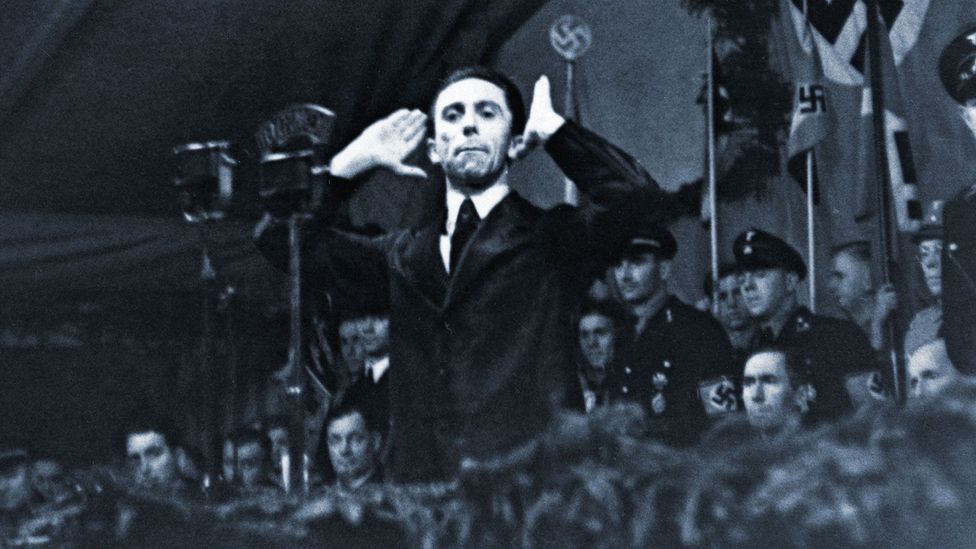
The 'illusion of truth' can be a dangerous weapon in the hands of a propagandist like Joseph Goebbels (Credit: Getty Images)
One obstacle is what you already know. Fifty-fifty if a lie sounds plausible, why would you set what yous know aside just considering you heard the lie repeatedly?
Recently, a team led past Lisa Fazio of Vanderbilt University set out to test how the illusion of truth effect interacts with our prior knowledge. Would it bear on our existing knowledge? They used paired true and un-true statements, but also divide their items co-ordinate to how likely participants were to know the truth (and then "The Pacific Sea is the largest ocean on World" is an example of a "known" items, which also happens to exist true, and "The Atlantic Ocean is the largest ocean on Earth" is an united nations-true item, for which people are likely to know the actual truth).
Their results prove that the illusion of truth event worked merely as strongly for known equally for unknown items, suggesting that prior knowledge won't preclude repetition from swaying our judgements of plausibility.
To cover all bases, the researchers performed ane study in which the participants were asked to rate how true each statement seemed on a half dozen-point calibration, and 1 where they just categorised each fact as "true" or "false". Repetition pushed the boilerplate item upwardly the 6-betoken scale, and increased the odds that a statement would be categorised as true. For statements that were really fact or fiction, known or unknown, repetition fabricated them all seem more believable.
Repetition tin even make known lies sound more believable (Credit: Alamy)
At first this looks like bad news for human rationality, but – and I tin't emphasise this strongly plenty – when interpreting psychological scientific discipline, y'all have to look at the actual numbers.
What Fazio and colleagues actually found, is that the biggest influence on whether a statement was judged to exist true was... whether it actually was true. The repetition result couldn't mask the truth. With or without repetition, people were still more likely to believe the actual facts every bit opposed to the lies.
This shows something primal nigh how we update our beliefs – repetition has a power to make things sound more true, even when nosotros know differently, but it doesn't over-ride that knowledge
The next question has to be, why might that exist? The answer is to do with the effort it takes to being rigidly logical about every piece of information you hear. If every time yous heard something you assessed it confronting everything you lot already knew, y'all'd still exist thinking well-nigh breakfast at supper-time. Considering we need to make quick judgements, we adopt shortcuts – heuristics which are right more ofttimes than wrong. Relying on how frequently you've heard something to judge how truthful something feels is simply one strategy. Whatsoever universe where truth gets repeated more than oftentimes than lies, even if merely 51% vs 49% will be 1 where this is a quick and dirty rule for judging facts.

The illusion of truth is non inevitable – when armed with knowledge, we can resist information technology (Credit: Getty Images)
If repetition was the only matter that influenced what we believed we'd be in trouble, only information technology isn't. Nosotros can all bring to bear more extensive powers of reasoning, simply we need to recognise they are a limited resources. Our minds are casualty to the illusion of truth effect considering our instinct is to utilize short-cuts in judging how plausible something is. Often this works. Sometimes it is misleading.
Once nosotros know about the effect nosotros tin can baby-sit against it. Office of this is double-checking why we believe what we do – if something sounds plausible is it because it really is truthful, or have we just been told that repeatedly? This is why scholars are so mad almost providing references - and then we tin can track the origin on whatever merits, rather than having to accept it on religion.
But part of guarding against the illusion is the obligation it puts on us to cease repeating falsehoods. We live in a world where the facts matter, and should thing. If you lot repeat things without bothering to check if they are true, you are helping to make a world where lies and truth are easier to misfile. So, please, think before yous echo.
--
Tom Stafford's ebook on when and how rational argument can alter minds is out at present. If you accept an everyday psychological phenomenon you'd similar to see written most in these columns please make it touch on with @tomstafford on Twitter, or ideas@idiolect.org.uk.
Join 700,000+ Future fans by liking u.s.a. on Facebook, or follow us on Twitter, Google+, LinkedIn and Instagram.
If y'all liked this story, sign upwards for the weekly bbc.com features newsletter, chosen "If You Only Read 6 Things This Week". A handpicked option of stories from BBC Future, Earth, Culture, Capital, Travel and Autos, delivered to your inbox every Friday.
hollowayhenter1962.blogspot.com
Source: https://www.bbc.com/future/article/20161026-how-liars-create-the-illusion-of-truth
0 Response to "A Lie Tole Over and Over Again"
Post a Comment