The testing of Jesus in Matthew 4
 As we enter the season of Lent on Sunday, the lectionary for the First Dominicus in Lent, Yr A, is of course Matt 4.1–11. It is worth noting that the lectionary and seasonal system of the 40 days (46 agenda days minus the feast days of Sundays that exempt united states of america from lenten discipline) corresponding to Jesus' testing in the desert, so leading straight into Easter, does something quite odd. For Jesus, the days of testing and bailiwick then led into a time (iii years according to the Fourth Gospel) of fruitful and powerful ministry, culminating in cross and resurrection, whereas in the agenda, this centre season is postponed till after Easter. Perhaps role of the reflection here is that Jesus' ministry building (in healing, teaching and deliverance) is anticipatory of the victory of Easter, and is only released to us by the power of the resurrection and outpouring of the Spirit at Pentecost, so this re-ordering does have theological value. And, equally we shall see, Matthew does make connections between the fourth dimension of testing and elements of the Passion narrative later in his gospel.
As I mentioned last twelvemonth, Felix Just, on his Catholic Resource page, includes a helpful table of comparison of the three Synoptic accounts of the temptations:
| . | Mark one:12-thirteen | Matthew 4:one-11 | Luke 4:one-thirteen |
| I n t r o | 12 And the Spirit immediately drove him out into the wilderness. 13 He was in the wilderness forty days, tempted by Satan; and he was with the wild beasts… | ane So Jesus was led up past the Spirit into the wilderness to be tempted by the devil. 2 He fasted xl days and twoscore nights, and later he was famished. | ane Jesus, full of the Holy Spirit, returned from the Jordan and was led by the Spirit in the wilderness, ii where for xl days he was tempted by the devil. He ate nix at all during those days, and when they were over, he was famished. |
| T # ane | x | 3 The tempter came and said to him, "If you are the Son of God, command these stones to become loaves of bread." 4 Only he answered, "It is written, 'One does not live by bread alone, but by every discussion that comes from the mouth of God.' " (cf. Deut 8:3cd) | 3 The devil said to him, "If yous are the Son of God, command this rock to become a loaf of bread." iv Jesus answered him, "It is written, 'I does not alive by breadstuff alone.' "(cf. Deut 8:3c) |
| T eastward thou p t # 2 | x | 5 And then the devil took him to the holy city and placed him on the pinnacle of the temple, half dozen saying to him, "If you are the Son of God, throw yourself down; for information technology is written, 'He volition command his angels apropos you,' and 'On their hands they volition bear you up, so that yous will non dash your human foot against a stone.' " (cf. Ps 91:11-12) 7 Jesus said to him, "Again it is written, 'Do not put the Lord your God to the exam.' " (cf. Deut 6:16) | 5 Then the devil led him up and showed him in an instant all the kingdoms of the world.half dozen And the devil said to him, "To yous I volition give their glory and all this say-so; for information technology has been given over to me, and I give information technology to anyone I please. 7 If you, and then, will worship me, it will all be yours." 8 Jesus answered him, "It is written, 'Worship the Lord your God, and serve only him.'" (cf. Deut half-dozen:13) |
| T e thousand p t # 3 | x | eight Again, the devil took him to a very high mount and showed him all the kingdoms of the globe and their splendor; 9 and he said to him, "All these I volition give you, if you will fall downwards and worship me." x Jesus said to him, "Away with y'all, Satan! for information technology is written, 'Worship the Lord your God, and serve only him.'" (cf. Deut 6:13) | 9 Then the devil took him to Jerusalem, and placed him on the pinnacle of the temple, proverb to him, "If you are the Son of God, throw yourself down from here, 10 for it is written, 'He will command his angels concerning you, to protect y'all,' 11 and 'On their hands they will carry you up, and then that you will not dash your foot against a stone.' " (cf. Ps 91:xi-12) 12 Jesus answered him, "It is said, 'Do not put the Lord your God to the exam.' " (cf. Deut 6:16) |
| Eastward n d | 13d – and the angels waited on him. | 11 And so the devil left him, and suddenly angels came and waited on him. | xiii When the devil had finished every test, he departed from him until an opportune time. |
This is helpful in both highlighting mutual themes drawn out past the three gospel writers, but also in highlighting different emphases.
A common theme is the tension between the apparent power of Satan, and the sovereignty of God in the whole consequence. Mark expresses this rather brutally—the Spirit 'throws' or 'drives' (ballo) Jesus into the desert—where Matthew and Luke are a little more measured. Only all three are also clear that Jesus was not lonely, contrary to some readings of this narrative, and also contrary to the rather miserable hymn I call back from school days, Pb us Heavenly Father, lead u.s.a., which included the lines:
solitary and dreary, faint and weary,
through the desert m didst become
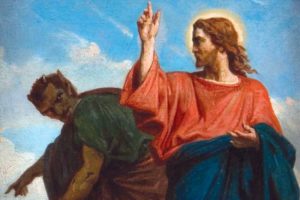
The temptations might not take been a handbag of laughs, but Jesus is not depicted as 'solitary and dreary'; in Mark he is ministered to by angels and the wild beasts, and Luke is clear that he goes 'filled with the Holy Spirit' and with the words of his Father's blessing ringing in his ears, and returns for ministry 'in the power of the Spirit' (Luke 4.fourteen). In Matthew, the sequences of tests builds to a triumphant climax where Jesus dismisses Satan forcefully, captured I think rather nicely in the painting above by Félix-Joseph Barrias, a forgotten 19th C painter who taught Edgar Degas.
Matthew's business relationship, in its opening, holds together the 2 forces at piece of work in this incident more clearly than either Luke or Mark. For these others, the Spirit throws or leads Jesus into the desert, and he meets testing in that location. But in Matt 4.1, the Spirit leads Jesus (literally, 'led upward', that is, upwardly from the river Jordan) with the clear purpose of his testing by Satan. Although Satan appears to have freedom and ability, this whole episode is actually firmly placed under the sovereignty of Jesus' loving Male parent.
This influences how we might translate the verbpeirazo. Although the traditional translation characterises this as the 'temptation' of Jesus (perhaps under the theological influence of 'he was tempted as nosotros are yet without sin' Heb 4.15), elsewhere in Matthew the verb is used in the quite unlike sense of Jesus being 'tested' by man opponents (Matt sixteen.1, 19.iii, 22.18, 35)—so nosotros should probably sympathise in this style hither equally well. For Matthew, this aligns Jesus' 40 days with the (roughly) xl years of Israel in the wilderness, where God 'tested' State of israel (ekpeirazo) to 'meet what was in your heart, whether or not you would continue his commandments' (Deut 8.two).
Mark does not even mention question of fasting in his summary account. Luke (mayhap writing for those less familiar with the biblical subject field of fasting?) emphasises the man reality that he ate nothing and and so was famished; but for Matthew this is a menstruation of 'xl days and nights' drawing his customary parallel with the experience of Moses (Ex 24.18, 34.28, Deut 9.ix) of supernatural provision. Given Matthew'due south interest in Elijah along with Moses, there is besides probable an echo of Elijah's time in the wilderness in one Kings 19.8. Surely the statement 'He was hungry' must rank as the greatest understatement in the New Attestation!
Jesus' opponent hither is described using three different terms: 'devil' (v one); 'the tempter' (5 3); and 'Satan' (on Jesus' lips, v 10). He is later described as 'Beelzebul' ('Lord of the flies') in Matt 12.24, and 'the Evil One' in Matt 13.19. The Erstwhile Attestation refers to this figure in different means (notably in ane Chron 21.1, Job 1–ii and Zech iii.1–2), but without this adult sense of Satan asthe cosmic opponent of God and his people. This idea adult in the intertestamental period, and it was a Jewish agreement that the early on followers of Jesus connected. The gathering together of the various OT titles, and basic characterisation of Satan equally the 'accuser' (the significant ofsatan in Hebrew anddiabolos in Greek) is plant in Rev 12.7–10).
Some interpreters accept suggested that these iii tests were related to Jesus' Messianic agenda: was Jesus going to chop-chop get together the crowds by impressive displays of divine power? But that thesis fails on two counts. First, Jesus does indeed perform 'signs and wonders' in his ministry, and this does indeed gather 'great crowds', which is one of Matthew's distinctive emphases. Second, the language of testing here has no audience in view other than Jesus himself. In fact (both in Luke and Matthew), the showtime and second (for Luke, get-go and third) tests rest on the claiming: 'If you are the Son of God…' This both looks back to the give-and-take of affidavit of Jesus by the Father at his baptism (Matt iii.17) but besides anticipates the test all the way to the cross, and Jesus' obedience to decease, in the taunts of the crowd (Matt 27.40).
Jesus' response to the first exam (equally for the others) is to cite Scripture, offering a well-rehearsed model for all his followers. It is notable that all three of his citations come from Deut 6–viii, the passages following the fundamental confession of Israel that 'God is I', theShema (Deut half dozen.4). (It has been suggested that the three temptations followed the structure of theShema in corresponding to the 'center, soul and strength' with which nosotros are to dear God—only this is not entirely convincing.) These are the texts which orthodox Jewish boys still need to larn past heart and recite at their bar mitzvah. Jewish Matthew records a fuller section of the verse than gentile-focussed Luke.
The first function of Deut viii.iii (which Jesus does not cite) sets the context of the exam every bit didactics Israel that there are more important things than fabric provision—even in relation to the apparently essential question of nutrient and beverage. Jesus' unrealistic practice here surely shapes his apparently unrealistic pedagogy that closely follows in Matt 6.25–34; Jesus expects us to learn the lessons of trust that he has learnt. There is a strange ironic pun in this maxim: rather than alive by what goes into our mouths and thus our stomachs, we live by what comes out of God's mouth, but goes in to our ears and thus our hearts. (There is a complementary actual irony in Jesus' teaching virtually what makes someone clean or unclean in Matt xv.11—not what goes into the mouth which then enters the stomach, but what comes out of the mouth which arises in the heart).
In both the second and third tests, the devil 'takes' or 'transports' Jesus to a high mountain, and so to the temple in Jerusalem. Although this is the usual give-and-take that Matthew uses, for case, in Joseph taking Mary in Matt two.13 and Jesus taking his disciples with him in Matt 17.one, we don't need to translate this as a literal journey. Apart from anything else, it is physically impossible to run across 'all the kingdoms of the world' from any vantage betoken, and then we should consider this every bit an exercise of the imagination, equally indeed many picture renditions of this episode advise (compare Ezekiel's visionary trip to Jerusalem in Ezek 8.1–3). For this reason, there is no need to try and identify exactly where the 'pinnacle' (pterygion) of the temple is. You can still sense, in Jerusalem today, the vertiginous drop from the corner of the Temple Mount into the Kidron Valley below, and in Jesus' day it would take been fifty-fifty further; to fall from in that location would mean certain death.
If Jesus can cite Scripture, and so so can the devil! James concurs with the narrative claim fabricated implicitly here: it is possible to know Scripture and know doctrine (James two.19) merely non 'know' God in trusting relationship. Jesus is here not disputing the truth of Ps 91.11, but is disputing the devil's utilize of it. When does looking to God'south provision and care cross over into making God our retainer, so that he answers our prayers as a response to our demands on him, rather than equally an answer to trust for his provision? The citation of Deut 6.16 looks back to the episode of Exodus 17.1–7, where Israel crossed just that line.
The sequential markers in Matthew ('then' v 5 and 'again' in 5 8) suggest that this was the original order of the tests, which Luke has altered to emphasise the importance of Jerusalem every bit the climax of Jesus' loyalty. But for Matthew and Jesus, and again reflecting theShema, the test underlying all the other tests is this one: whom do nosotros really worship? Here, Satan'due south mask falls abroad, and all pretence at 'biblical' justification disappears from view. In that location is no sense of unwarranted hubris on Satan's part in the claim he makes; he is repeatedly described in the NT as 'the ruler of this earth' (e.1000. John 12.31, two Cor 4.4, Eph half dozen.eleven, 1 John five.19, Rev 12.9–17) which means that it his real ability that Jesus overcomes in these tests, as a sign pointing to the real victory of the cross which releases the real power of the Spirit to effect real victory in the lives of Jesus' followers.
There can be only one answer for Jesus: that we should 'worship' (the meaning of 'fearfulness' in Deut 6.13) the Lord our God. Jesus summarily dismisses Satan with the same wording that he dismisses the suggestion of Peter that he should avoid suffering in Matt 16.23.
When eventually Jesus is able to claim on some other mountain that 'all authority has been given to me', it volition be as a effect not of kowtowing to Satan but of suffering in obedience to God's purpose, and so it will exist all authority not only on earth simply likewise in sky, an authorization which the devil was non able to offer (Matt 28.xviii). (R T France, NICNT, p135)
Though Luke comments explicitly that Satan will return 'at the opportune time', we can see implicit hints of this in Matthew's later narrative. In the meantime, Matthew tells us, 'behold' angels come up and minister to him, using his characteristicidou to communicate the suddenness of the alter, as Satan departs, and the angelic aid promised in Ps 91.11 comes to him in God's timing and with his provision.
Two final things are worth noting. Outset, the only style that we could have this narrative (assuming information technology is not only imagined) is to note that (hither and elsewhere) Jesus must have been 'in the unfortunate habit of regaling his disciples with his personal experiences of God'. Peradventure this is non a bad habit for any leader to adopt.
Secondly, the temptations of Jesus are often preached as though they were moral examples for us to follow: we should go into the desert; we should face our demons; we should quote from Scripture; and and so on. But to preach in this way is in danger of missing the about of import thing in preaching: not to put ourselves in the narrative as if nosotros were the most important discipline, simply to notation what God is doing and what God has washed. The focus for all three gospels writers is that Jesus has undone the failures of both Israel and Adam; when we are incorporate into Jesus, we are incorporated into this victory, and nosotros share in it by grace rather than by our own efforts. That does not mean, every bit we face temptations and challenges this Lent, we can avert the challenge of discipline and endeavour. Just we face these things knowing that Jesus conquered them, in the ability of the Spirit, and that the same Spirit is God'due south gift to u.s.a., and it is his presence that brings victory and enables us to exist 'more than than conquerors' (Rom 8.37; compare Rev 2.seven and parallels).
Jesus is here not then much a model for us to follow, but a saviour for united states of america to exist rescued and secured by.
If yous constitute this article helpful, share information technology on social media using the buttons on the left. Follow me on Twitter @psephizo.Similar my page on Facebook.
Much of my work is done on a freelance basis. If you have valued this mail service, would y'all considerdonating £i.20 a month to support the production of this blog?
If y'all enjoyed this, do share information technology on social media (Facebook or Twitter) using the buttons on the left. Follow me on Twitter @psephizo. Similar my page on Facebook.
Much of my work is done on a freelance basis. If you lot have valued this mail service, y'all can brand a single or repeat donation through PayPal:
Comments policy: Expert comments that engage with the content of the postal service, and share in respectful debate, can add existent value. Seek outset to understand, then to be understood. Make the most charitable construal of the views of others and seek to learn from their perspectives. Don't view debate as a conflict to win; address the argument rather than tackling the person.
hollowayhenter1962.blogspot.com
Source: https://www.psephizo.com/biblical-studies/the-testing-of-jesus-in-matthew-4/
0 Response to "The testing of Jesus in Matthew 4"
Post a Comment